ILLUSTRATION: MAARTEN HUIZING


PHOTO: SAUL LOEB / ANP

CEO of Meta and Facebook Mark Zuckerberg, Lauren Sanchez, Amazon founder Jeff Bezos, Google CEO Sundar Pichai and Tesla and SpaceX CEO Elon Musk attend the inauguration ceremony before Donald Trump is sworn in as the 47th US President in the US Capitol Rotunda in Washington, DC, on January 20, 2025.
6
5
4
3
2
1
The University of Groningen isn’t the only one that can manage without Big Tech…
There are alternatives
The realisation that other options exist is the beginning of an autonomous existence. Try a different browser, search engine, or email service. Replace WhatsApp with Signal (an open-source messaging app). Choose Proton (privacy-friendly email and cloud storage). Consider Mastodon or Bluesky as decentralised alternatives to X (formerly Twitter).
Small steps help
You don’t have to do everything at once. Don’t make it too big. Switching to a different web browser, for example from Google Chrome to the European Vivaldi, already makes a difference. The same applies to companies or organisations. Switching all at once feels overwhelming and will likely cause chaos. Therefore, reduce dependence step by step.
If you choose, do so consciously
Digital autonomy starts with knowledge, or digital literacy. Read up on the possibilities and limitations. There are tens of thousands of alternatives, but not all options are easy to find. Not switching is also a conscious choice, for example because no good alternative is yet available.
Start a conversation
What are decision-makers doing to achieve greater digital autonomy? Have a discussion about it. What is your employer doing, and what are local policy makers doing? Another way to make a difference is through the ballot box. Nerdvote collected candidate MPs who are committed to digital autonomy, privacy, and cybersecurity.
Think of an exit strategy
This applies mainly to organisations or companies. The past decade’s mantra was: ‘Everything to the cloud’. Now we need to think about the question: how do we get out? Not only because of geopolitical tensions. Sometimes it’s also a simple calculation: licence costs can skyrocket if dependence becomes too great…
Develop your own vision
One more for companies and organisations. Digital autonomy is more than technology. Digital infrastructure determines who or what you are. Develop a vision for digitalisation and set your own course. Are we using AI because Microsoft offers it, or does it actually improve our work?
6 tips from Oskar


Marijke Folgering
Oskar Gstrein
Nolda Tipping-Griffioen


I
t was rightly a wake-up call: the second term of US President Donald Trump, followed by a barrage of measures. Scientists, for example, received questionnaires about topics such as gender, diversity, and climate. Major American tech companies almost immediately bowed to the new winds from
PROPOSITION
Daniela Jou-Valencia – Faculteit Medische Wetenschappen
‘We delight in the beauty of the butterfly but rarely admit the changes it has gone through to
achieve that beauty.’ (Maya Angelo)
TEXT: JELLE POSTHUMA
The University of Groningen is charting a course towards digital autonomy. By 2030,
the university aims to no longer be dependent on major American tech companies.
‘We want to determine for ourselves who we collaborate with.’
Walled gardens
According to Gstrein, switching to alternatives to Big Tech is entirely feasible. ‘I myself stopped using macOS as the operating system for my laptop and switched to Linux. It works fine, and it’s not that complicated at all. Of course, it doesn’t work the same way. But this is about our very legitimacy as a university. If we do nothing, we will soon have no control over our education and research.’
The switch primarily requires a change in behaviour, the researcher continues. ‘A different mindset is needed. It’s about realising that there are choices.’ According to him, the major providers create ‘walled gardens’. Within these walled gardens, users only see part of the internet. ‘This doesn’t align with the original ideology of the internet, and it doesn’t fit with our democratic society.’ The awareness that there is freedom of choice must also be conveyed to students. ‘We’re still doing too little of that,’ says Gstrein. ‘There needs to be more focus on training a young generation to be digitally autonomous.’
Persuading and enthusing
For operations and education, alternatives are available in the relatively short term, Gstrein states. For research, it’s more complicated. Folgering adds: ‘In research, developments are rapid. The faculties have considerable autonomy to determine which software they use. That’s also perfectly logical: scientists want the best tools to carry out their research.’ But this individual autonomy results in less impact at a collective level, says Gstrein. ‘A cultural change is also needed here.’
Digital autonomy won’t happen by decree, Tipping-Griffioen emphasises. ‘As a university, we are not centrally organised. If we want to achieve something, we need to enthuse and convince students and staff.’ Hence the focus on grassroots ideas, just like the movement that started with the petition. And isn’t that how the internet itself originated and developed further?
Academic freedom, independence, and security
Not long after the geopolitical upheaval, a petition began circulating in Groningen. Signed by a group of staff, it called on the UG to break away from Google, Microsoft, Amazon, and other major American providers. Gstrein was one of the initiators. ‘Given Trump’s re-election, the timing was good. But the issue had been brewing for much longer. The petition is primarily about how we, as a university, can regain control.’
The Executive Board of the University supported the movement, and significant steps have been taken in recent periods, say Gstrein and Tipping-Griffioen. The Alliance for Digital Autonomy (ADA), a coalition of various parties within the UG, developed a so-called ‘roadmap’, which has led to a programme aimed at reducing the university’s dependence. Three principles are central: academic freedom, independence, and security.
The university’s ambition is firm: by 2030, the UG wants to be less dependent on Big Tech. ‘In the media, it was sometimes a bit distorted,’ says Tipping-Griffioen. ‘As if the UG wanted to be completely free of Big Tech by 2030. It’s a bit more nuanced. In four years, we want to have the freedom to choose for ourselves who we work with. Right now, we’re still in a vendor lock-in: we are heavily dependent on a single provider, and switching is difficult. We want to break that – but such a thing isn’t arranged on a Friday afternoon.’
The movement aligns with broader initiatives in the field of digital sovereignty, which focus on control and ownership of digital infrastructure. Together with the northern educational institutions, the UG has developed the Bach programme: a national impulse for talent development in the field of digital sovereignty.
Searching for alternatives
Marijke Folgering, who has been appointed as a quartermaster and programme manager for digital autonomy, is mapping out what the university is already doing and where the risks lie regarding digital autonomy, starting with the ‘critical systems’. A lot is already going well: for example, the UG has its own data storage, and the computing power via the High Performance Computing (HPC) cluster is autonomous.
However, not all activities have a readily available alternative, Folgering continues. ‘That’s why we sometimes need to take intermediate steps. For our education platform Brightspace, for example, we are still dependent on Amazon Web Services (AWS). All alternative providers also use Amazon. We are in discussions with the supplier to encourage them to store data in a more secure manner.’
Collaboration with other Dutch universities, for example within Universities of the Netherlands (UNL), is also of great importance. ‘You don’t want everyone to reinvent the wheel,’ says Folgering. A good example is the development of Nextcloud, an open-source service as an alternative to the Google environment. The system offers email, file storage, and video calling, among other things.
Who is in charge?
‘We had already been working on the topic of digital autonomy for some time, but these geopolitical changes suddenly gave it a higher urgency,’ says Nolda Tipping-Griffioen. She is director of the Center for Information Technology (CIT) and Chief Information Officer of the University of Groningen. ‘I myself felt that we needed to protect our scientists from this, because the UG, too, is far too dependent on these American Big Tech companies.’
Oskar Gstrein, associate professor with the chair of Data Governance and Digital Autonomy at the UG, points to the major role of digital infrastructure within the university. Many activities in the fields of education, research, and support take place on cloud services, often provided by American companies. Students and staff, for example, use Google’s services daily for their email, documents, calendars, and storage. Artificial intelligence (AI) also plays an increasingly important role.
This dependence risks the university losing control over its research and education, Gstrein argues. ‘We need to think much more carefully about what happens to our data and what position we take as a university. What is our role as a university? Have we become some kind of highly advanced customer of Big Tech? The key is that we can make conscious choices and retain control over our digital infrastructure. Without a well-considered approach, others will decide for us.’
Washington.
ILLUSTRATION: MAARTEN HUIZING

PROPOSITION
Daniela Jou-Valencia – Faculteit Medische Wetenschappen
‘We delight in the beauty of the butterfly but rarely admit the changes it has gone through to
achieve that beauty.’ (Maya Angelo)
6 tips from Oskar
The University of Groningen isn’t the only one that can manage without Big Tech…
1 There are alternatives
The realisation that other options exist is the beginning of an autonomous existence. Try a different browser, search engine, or email service. Replace WhatsApp with Signal (an open-source messaging app). Choose Proton (privacy-friendly email and cloud storage). Consider Mastodon or Bluesky as decentralised alternatives to X (formerly Twitter).
2 Small steps help
You don’t have to do everything at once. Don’t make it too big. Switching to a different web browser, for example from Google Chrome to the European Vivaldi, already makes a difference. The same applies to companies or organisations. Switching all at once feels overwhelming and will likely cause chaos. Therefore, reduce dependence step by step.
3 If you choose, do so consciously
Digital autonomy starts with knowledge, or digital literacy. Read up on the possibilities and limitations. There are tens of thousands of alternatives, but not all options are easy to find. Not switching is also a conscious choice, for example because no good alternative is yet available.
4 Start a conversation
What are decision-makers doing to achieve greater digital autonomy? Have a discussion about it. What is your employer doing, and what are local policy makers doing? Another way to make a difference is through the ballot box. Nerdvote collected candidate MPs who are committed to digital autonomy, privacy, and cybersecurity.
5 Think of an exit strategie
This applies mainly to organisations or companies. The past decade’s mantra was: ‘Everything to the cloud’. Now we need to think about the question: how do we get out? Not only because of geopolitical tensions. Sometimes it’s also a simple calculation: licence costs can skyrocket if dependence becomes too great…
6 Develop your own vision
One more for companies and organisations. Digital autonomy is more than technology. Digital infrastructure determines who or what you are. Develop a vision for digitalisation and set your own course. Are we using AI because Microsoft offers it, or does it actually improve our work?


CEO of Meta and Facebook Mark Zuckerberg, Lauren Sanchez, Amazon founder Jeff Bezos, Google CEO Sundar Pichai and Tesla and SpaceX CEO Elon Musk attend the inauguration ceremony before Donald Trump is sworn in as the 47th US President in the US Capitol Rotunda in Washington, DC, on January 20, 2025.
Walled gardens
According to Gstrein, switching to alternatives to Big Tech is entirely feasible. ‘I myself stopped using macOS as the operating system for my laptop and switched to Linux. It works fine, and it’s not that complicated at all. Of course, it doesn’t work the same way. But this is about our very legitimacy as a university. If we do nothing, we will soon have no control over our education and research.’
The switch primarily requires a change in behaviour, the researcher continues. ‘A different mindset is needed. It’s about realising that there are choices.’ According to him, the major providers create ‘walled gardens’. Within these walled gardens, users only see part of the internet. ‘This doesn’t align with the original ideology of the internet, and it doesn’t fit with our democratic society.’ The awareness that there is freedom of choice must also be conveyed to students. ‘We’re still doing too little of that,’ says Gstrein. ‘There needs to be more focus on training a young generation to be digitally autonomous.’
Persuading and enthusing
For operations and education, alternatives are available in the relatively short term, Gstrein states. For research, it’s more complicated. Folgering adds: ‘In research, developments are rapid. The faculties have considerable autonomy to determine which software they use. That’s also perfectly logical: scientists want the best tools to carry out their research.’ But this individual autonomy results in less impact at a collective level, says Gstrein.
‘A cultural change is also needed here.’
Digital autonomy won’t happen by decree, Tipping-Griffioen emphasises. ‘As a university, we are not centrally organised. If we want to achieve something, we need to enthuse and convince students and staff.’ Hence the focus on grassroots ideas, just like the movement that started with the petition. And isn’t that how the internet itself originated and developed further?
PHOTO: SAUL LOEB / ANP

Academic freedom, independence, and security
Not long after the geopolitical upheaval, a petition began circulating in Groningen. Signed by a group of staff, it called on the UG to break away from Google, Microsoft, Amazon, and other major American providers. Gstrein was one of the initiators. ‘Given Trump’s re-election, the timing was good. But the issue had been brewing for much longer. The petition is primarily about how we, as a university, can regain control.’
The Executive Board of the University supported the movement, and significant steps have been taken in recent periods, say Gstrein and Tipping-Griffioen. The Alliance for Digital Autonomy (ADA), a coalition of various parties within the UG, developed a so-called ‘roadmap’, which has led to a programme aimed at reducing the university’s dependence. Three principles are central: academic freedom, independence, and security.
The university’s ambition is firm: by 2030, the UG wants to be less dependent on Big Tech. ‘In the media, it was sometimes a bit distorted,’ says Tipping-Griffioen. ‘As if the UG wanted to be completely free of Big Tech by 2030. It’s a bit more nuanced. In four years, we want to have the freedom to choose for ourselves who we work with. Right now, we’re still in a vendor lock-in: we are heavily dependent on a single provider, and switching is difficult. We want to break that – but such a thing isn’t arranged on a Friday afternoon.’
The movement aligns with broader initiatives in the field of digital sovereignty, which focus on control and ownership of digital infrastructure. Together with the northern educational institutions, the UG has developed the Bach programme: a national impulse for talent development in the field of digital sovereignty.
Searching for alternatives
Marijke Folgering, who has been appointed as a quartermaster and programme manager for digital autonomy, is mapping out what the university is already doing and where the risks lie regarding digital autonomy, starting with the ‘critical systems’. A lot is already going well: for example, the UG has its own data storage, and the computing power via the High Performance Computing (HPC) cluster is autonomous.
However, not all activities have a readily available alternative, Folgering continues. ‘That’s why we sometimes need to take intermediate steps. For our education platform Brightspace, for example, we are still dependent on Amazon Web Services (AWS). All alternative providers also use Amazon. We are in discussions with the supplier to encourage them to store data in a more secure manner.’
Collaboration with other Dutch universities, for example within Universities of the Netherlands (UNL), is also of great importance. ‘You don’t want everyone to reinvent the wheel,’ says Folgering. A good example is the development of Nextcloud, an open-source service as an alternative to the Google environment. The system offers email, file storage, and video calling, among other things.
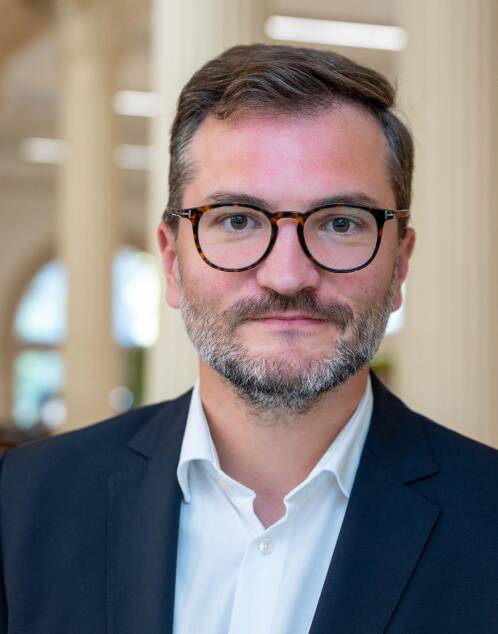
Marijke Folgering
Oskar Gstrein
Nolda Tipping-Griffioen



Who is in charge?
‘We had already been working on the topic of digital autonomy for some time, but these geopolitical changes suddenly gave it a higher urgency,’ says Nolda Tipping-Griffioen. She is director of the Center for Information Technology (CIT) and Chief Information Officer of the University of Groningen. ‘I myself felt that we needed to protect our scientists from this, because the UG, too, is far too dependent on these American Big Tech companies.’
Oskar Gstrein, associate professor with the chair of Data Governance and Digital Autonomy at the UG, points to the major role of digital infrastructure within the university. Many activities in the fields of education, research, and support take place on cloud services, often provided by American companies. Students and staff, for example, use Google’s services daily for their email, documents, calendars, and storage. Artificial intelligence (AI) also plays an increasingly important role.
This dependence risks the university losing control over its research and education, Gstrein argues. ‘We need to think much more carefully about what happens to our data and what position we take as a university. What is our role as a university? Have we become some kind of highly advanced customer of Big Tech? The key is that we can make conscious choices and retain control over our digital infrastructure. Without a well-considered approach, others will decide for us.’
measures. Scientists, for example, received questionnaires about topics such as gender, diversity, and climate. Major American tech companies almost immediately bowed to the new winds from Washington.
t was rightly a wake-up call: the second term of US President Donald Trump, followed by a barrage of
I
The University of Groningen is charting a course towards digital autonomy. By 2030, the university aims to no longer be dependent on major American tech companies. ‘We want to determine for ourselves who we collaborate with.’
TEXT: JELLE POSTHUMA