

PHOTO:SANDER KONING / ANP
PROPOSITION
break down PFAS
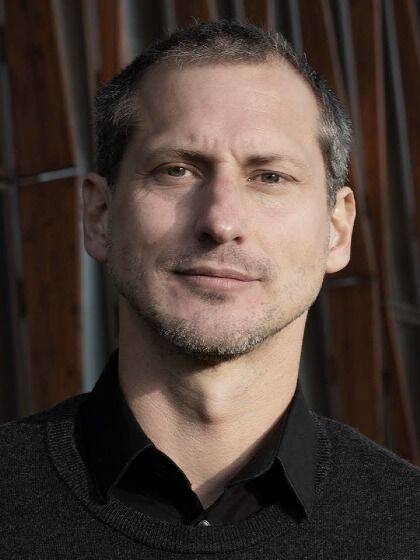
Clemens Mayer (Austria, 1985) studied Chemistry and Biotechnology in Graz and earned his PhD from ETH Zürich. After postdoctoral research in Cambridge (UK), Mayer joined the UG in 2016 and is now associate professor of Molecular Evolution. His research focuses on blending chemistry and biology to make biomolecules to order. In 2023 he was named PhD Supervisor of the Year in the Faculty of FSE.
Lucas Philipp Gartzke – Faculteit Medische Wetenschappen
Lesen schadet der Dummheit. (Papa)
TEXT: NIENKE BEINTEMA
PFAS are among the most persistent chemicals ever made. Nature – and conventional wastewater treatment – cannot break them down. Chemist Clemens Mayer is searching for enzymes that can do just that. How? By harnessing evolution among bacteria.
Before we get to the details – why were PFAS developed in the first place?
“PFAS have proven to be incredibly useful for a wide range of applications, precisely because they are so stable. They contain what we call C-F bonds: chemical bonds between a carbon and a fluorine atom. And this is one of the strongest chemical bonds that we know. It makes PFAS extremely resistant to chemical and biological degradation. Teflon coating is perhaps one of the first and best-known applications. Similar compounds are used in firefighting foams, in packaging, shampoos, lubricants for machines – really all kinds of industrial and consumer products. But the properties that make PFAS so attractive are in fact the reason they don’t degrade.”
Do they occur naturally at all?
“There are only about a dozen naturally occurring compounds containing a C–F bond. One of those is called fluoroacetate, and it is found in several unrelated plant species. These plants are generally poisonous to herbivores. But certain cattle species have bacteria in their gut that have evolved to degrade this compound. They do so using an enzyme – the only enzyme known to be able to break
a C-F bond.”
Why are eggs from the supermarket OK to eat, while eggs from backyard chickens contain too much PFAS?
“PFAS easily spread throughout the environment. They accumulate in soil, because they’re not degraded by microorganisms. Curiously, they concentrate in earthworms, which eat a lot of soil throughout their lifetime and don’t degrade the PFAS either. And then they accumulate in chickens that eat those worms, and finally they end up in high concentrations in their eggs. Industrially farmed chickens mainly eat grains, which is a shorter food chain with much less accumulation.”
If they’re so harmful, why aren’t PFAS banned?
“That would be very complicated, legally, because there are tens of thousands of PFAS in use worldwide. You would basically have to ban a whole class of compounds. But for some critical applications there is simply no alternative. And there are entire chains of stakeholders, so it’s basically unfeasible. We’ll keep accumulating them.”
There’s currently no way to get rid of them?
“At the moment, we can remove PFAS from contaminated soil through complex washing techniques, but that doesn’t mean we’ve destroyed them. We just concentrate them and move them somewhere else. There are technologies aimed at destroying PFAS, but they use a lot of energy. Not to mention the financial burden. A study commissioned by the EC, published earlier this year, estimates the annual cost of cleaning up PFAS to be around 3.8 billion euros in Europe alone. And that can go up to 80 billion a year under the most stringent regulatory scenario.”
But… is that really the strategy: cleaning them up?
“We have to, right? There’s no other way. The societal and environmental challenges are so high that technologies for PFAS remediation will be developed. Scientists all over the world are looking for better ways to detect, filter, and destroy those compounds. Here at the UG, we would like to be in the third category. Our specialty is developing new enzymes: proteins that can catalyse reactions between other compounds – for instance breaking down C-F bonds.”
How would you go about degrading this ‘indestructible’ C-F bond?
“Well, here we turn to Nature. Remember these bacteria in cow guts that are able to break the C-F bond in fluoroacetate? The enzyme that they use to do this is incredibly efficient: one enzyme – one protein molecule – breaks down fifty C-F bonds per second. It does that by itself, at room temperature, on-site, so it’s much more sustainable than the high-energy methods we would otherwise use. So, imagine, if you could convince this enzyme to cleave PFAS… or, more precisely, if you could convince these bacteria to produce a slightly modified enzyme…”
How do you ‘convince’ bacteria to do something?
“We use nature’s all-purpose problem solver – evolution. It’s the best producer of biomolecules that are perfect for a certain job. Basically, we introduce mutations into the DNA of bacteria so that some of them produce slightly different versions of an enzyme. Hundreds of thousands of distinct variations, in fact. We then give them only a fluorinated compound as food. The ones who can’t break it down, die. Those few whose enzymes are able to break the carbon–fluorine bond, survive. Those bacteria are used to produce the next generation of enzymes, and the process is repeated, gradually improving the enzyme’s efficiency.”
And how successful is this? How close are you to breaking down PFAS?
Mayer laughs. “Aaaah, well, here’s where it gets tricky. As soon as you add another C-atom to your carbon chain, or a second F to a C, the enzymes become much, much slower. Fluoroacetate, the naturally occurring compound, has only two C’s and one F. We’ve managed to break a compound with one extra C, or two F’s. But PFAS generally have long chains of C’s, each with two F’s. We are slowly, gradually moving towards enzymes that perform better. But bacteria are sometimes very frustrating to work with: they use thousands of molecular pathways, so as soon as we try to force them to do what we want, they often find a way around it.”
But you’re discovering useful new insights along the way?
“Oh absolutely. We’re learning a lot about the structural properties of these enzymes, the effect of certain mutations, the efficiency of enzyme variants and how to speed up reactions drastically... It’s really fundamental science. There’s new information in everything that we do. And this has much wider applications, from chemical engineering to drug discovery. So, we don’t know yet where our research will end – but whatever happens, it will be interesting.”
PFAS (per- and polyfluoroalkyl substances) are everywhere – in the environment, in our bodies, and in the media. They accumulate in water and soil, in remote polar areas, in our food, in chicken’s eggs and even in breast milk. There is mounting scientific evidence linking PFAS to health issues, including immune and liver problems, reduced birth weight and some cancers.
Meanwhile, Nature seems incapable of getting rid of these compounds. UG biochemist Clemens Mayer is convinced there must be a way. Together with his PhD students, he is developing a method using Nature’s very own principles of evolution to ‘teach’ bacteria how to dismantle PFAS.
PHOTO:SANDER KONING / ANP

PROPOSITION
Lucas Philipp Gartzke – Faculteit Medische Wetenschappen
Lesen schadet der Dummheit. (Papa)
Before we get to the details – why were PFAS developed in the first place?
“PFAS have proven to be incredibly useful for a wide range of applications, precisely because they are so stable. They contain what we call C-F bonds: chemical bonds between a carbon and a fluorine atom. And this is one of the strongest chemical bonds that we know. It makes PFAS extremely resistant to chemical and biological degradation. Teflon coating is perhaps one of the first and best-known applications. Similar compounds are used in firefighting foams, in packaging, shampoos, lubricants for machines – really all kinds of industrial and consumer products. But the properties that make PFAS so attractive are in fact the reason they don’t degrade.”
Do they occur naturally at all?
“There are only about a dozen naturally occurring compounds containing a C–F bond. One of those is called fluoroacetate, and it is found in several unrelated plant species. These plants are generally poisonous to herbivores. But certain cattle species have bacteria in their gut that have evolved to degrade this compound. They do so using an enzyme – the only enzyme known to be able to break
a C-F bond.”
Why are eggs from the supermarket OK to eat, while eggs from backyard chickens contain too much PFAS?
“PFAS easily spread throughout the environment. They accumulate in soil, because they’re not degraded by microorganisms. Curiously, they concentrate in earthworms, which eat a lot of soil throughout their lifetime and don’t degrade the PFAS either. And then they accumulate in chickens that eat those worms, and finally they end up in high concentrations in their eggs. Industrially farmed chickens mainly eat grains, which is a shorter food chain with much less accumulation.”
If they’re so harmful, why aren’t PFAS banned?
“That would be very complicated, legally, because there are tens of thousands of PFAS in use worldwide. You would basically have to ban a whole class of compounds. But for some critical applications there is simply no alternative. And there are entire chains of stakeholders, so it’s basically unfeasible. We’ll keep accumulating them.”
There’s currently no way to get rid of them?
“At the moment, we can remove PFAS from contaminated soil through complex washing techniques, but that doesn’t mean we’ve destroyed them. We just concentrate them and move them somewhere else. There are technologies aimed at destroying PFAS, but they use a lot of energy. Not to mention the financial burden. A study commissioned by the EC, published earlier this year, estimates the annual cost of cleaning up PFAS to be around 3.8 billion euros in Europe alone. And that can go up to 80 billion a year under the most stringent regulatory scenario.”
But… is that really the strategy: cleaning them up?
“We have to, right? There’s no other way. The societal and environmental challenges are so high that technologies for PFAS remediation will be developed. Scientists all over the world are looking for better ways to detect, filter, and destroy those compounds. Here at the UG, we would like to be in the third category. Our specialty is developing new enzymes: proteins that can catalyse reactions between other compounds – for instance breaking down C-F bonds.”
How would you go about degrading this ‘indestructible’ C-F bond?
“Well, here we turn to Nature. Remember these bacteria in cow guts that are able to break the C-F bond in fluoroacetate? The enzyme that they use to do this is incredibly efficient: one enzyme – one protein molecule – breaks down fifty C-F bonds per second. It does that by itself, at room temperature, on-site, so it’s much more sustainable than the high-energy methods we would otherwise use. So, imagine, if you could convince this enzyme to cleave PFAS… or, more precisely, if you could convince these bacteria to produce a slightly modified enzyme…”
How do you ‘convince’ bacteria to do something?
“We use nature’s all-purpose problem solver – evolution. It’s the best producer of biomolecules that are perfect for a certain job. Basically, we introduce mutations into the DNA of bacteria so that some of them produce slightly different versions of an enzyme. Hundreds of thousands of distinct variations, in fact. We then give them only a fluorinated compound as food. The ones who can’t break it down, die. Those few whose enzymes are able to break the carbon–fluorine bond, survive. Those bacteria are used to produce the next generation of enzymes, and the process is repeated, gradually improving the enzyme’s efficiency.”
And how successful is this? How close are you to breaking down PFAS?
Mayer laughs. “Aaaah, well, here’s where it gets tricky. As soon as you add another C-atom to your carbon chain, or a second F to a C, the enzymes become much, much slower. Fluoroacetate, the naturally occurring compound, has only two C’s and one F. We’ve managed to break a compound with one extra C, or two F’s. But PFAS generally have long chains of C’s, each with two F’s. We are slowly, gradually moving towards enzymes that perform better. But bacteria are sometimes very frustrating to work with: they use thousands of molecular pathways, so as soon as we try to force them to do what we want, they often find a way around it.”
But you’re discovering useful new insights along the way?
“Oh absolutely. We’re learning a lot about the structural properties of these enzymes, the effect of certain mutations, the efficiency of enzyme variants and how to speed up reactions drastically... It’s really fundamental science. There’s new information in everything that we do. And this has much wider applications, from chemical engineering to drug discovery. So, we don’t know yet where our research will end – but whatever happens, it will be interesting.”
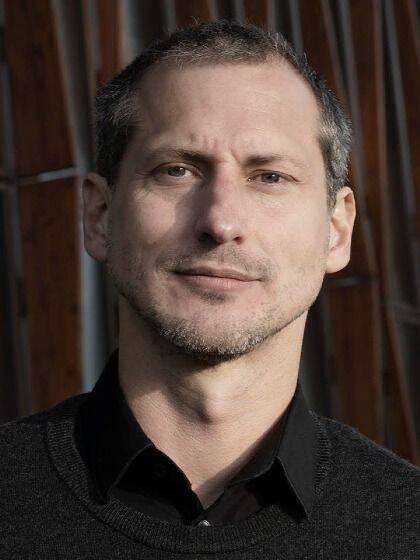
Clemens Mayer (Austria, 1985) studied Chemistry and Biotechnology in Graz and earned his PhD from ETH Zürich. After postdoctoral research in Cambridge (UK), Mayer joined the UG in 2016 and is now associate professor of Molecular Evolution. His research focuses on blending chemistry and biology to make biomolecules to order. In 2023 he was named PhD Supervisor of the Year in the Faculty of FSE.
PFAS (per- and polyfluoroalkyl substances) are everywhere – in the environment, in our bodies, and in the media. They accumulate in water and soil, in remote polar areas, in our food, in chicken’s eggs and even in breast milk. There is mounting scientific evidence linking PFAS to health issues, including immune and liver problems, reduced birth weight and some cancers.
Meanwhile, Nature seems incapable of getting rid of these compounds. UG biochemist Clemens Mayer is convinced there must be a way. Together with his PhD students, he is developing a method using Nature’s very own principles of evolution to ‘teach’ bacteria how to dismantle PFAS.
PFAS are among the most persistent chemicals ever made. Nature – and conventional wastewater treatment – cannot break them down. Chemist Clemens Mayer is searching for enzymes that can do just that. How? By harnessing evolution among bacteria.
TEXT: NIENKE BEINTEMA
break down PFAS