

PHOTO:HERMAN ENGBERS / DE BEELDUNIE

against spring
PROPOSITION
Nohora Rueda Forero – Medische Wetenschappen
Viruses are tiny, but their impact is huge, proof that bad things (and good) come in small packages.
PHOTO:HERMAN ENGBERS / DE BEELDUNIE
Christiaan Both (1969) has been a keen birdwatcher since childhood. He studied biology in Wageningen, Groningen, and Oxford, and in 2012 became Professor of Animal Ecology at the University of Groningen. Both investigates the impact of climate change on bird phenology, and his work on migratory birds is internationally renowned.
TEXT: NIENKE BEINTEMA
25 years ago, biologist Christiaan Both was one of the researchers who discovered a mismatch between birds’ breeding season and the timing of peak food supply, with many birds breeding too late with spring coming earlier. Follow-up research has shown that birds are capable of adapting, but does this apply to all species and can they adapt quickly enough?
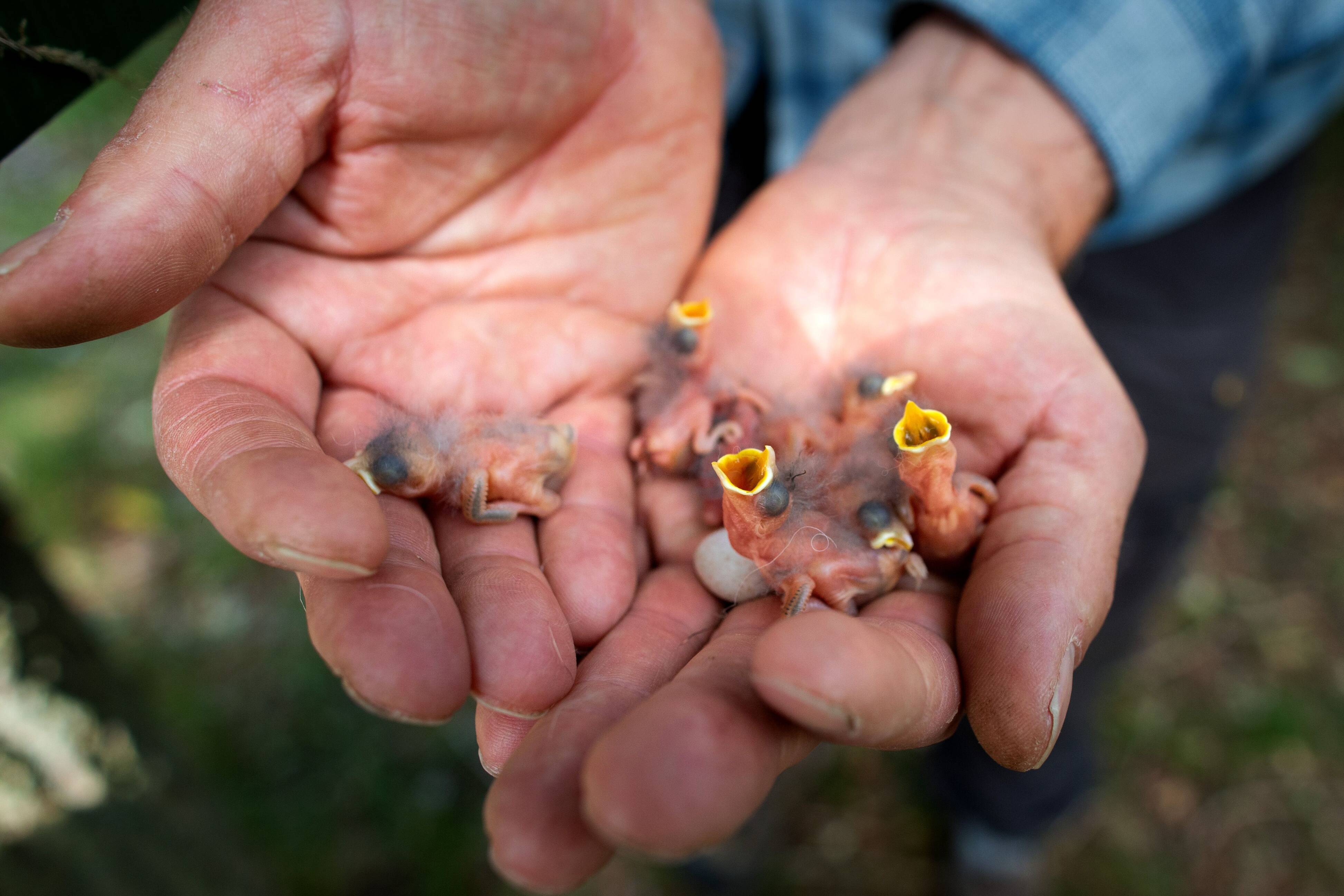
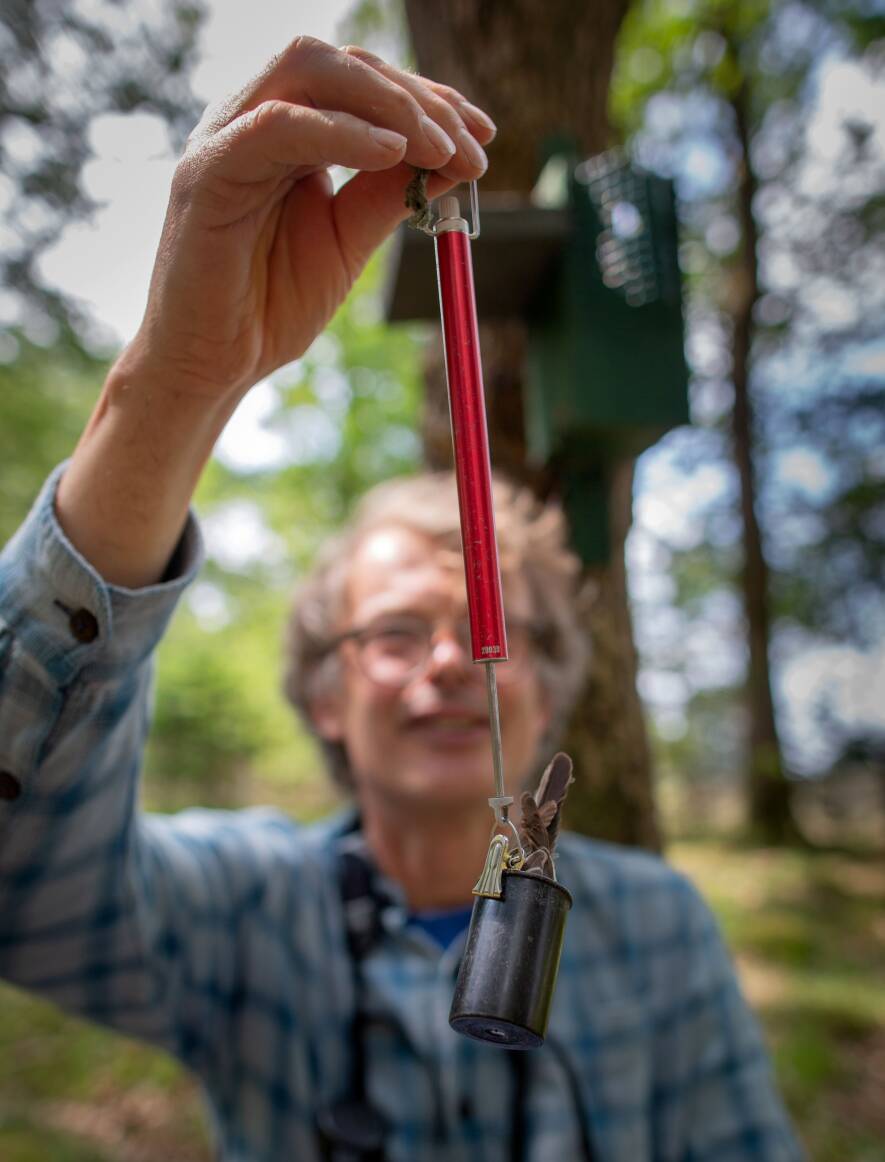
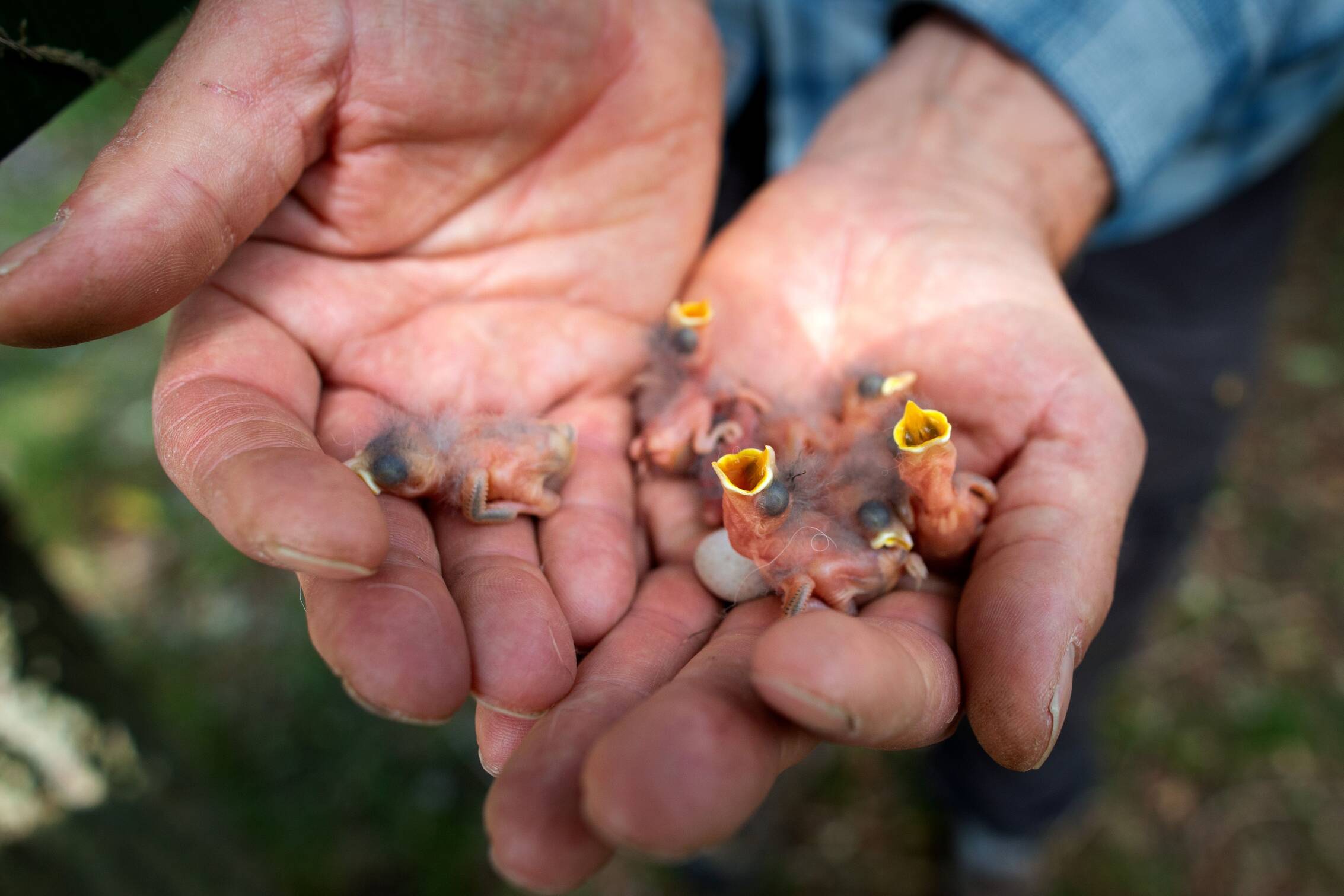
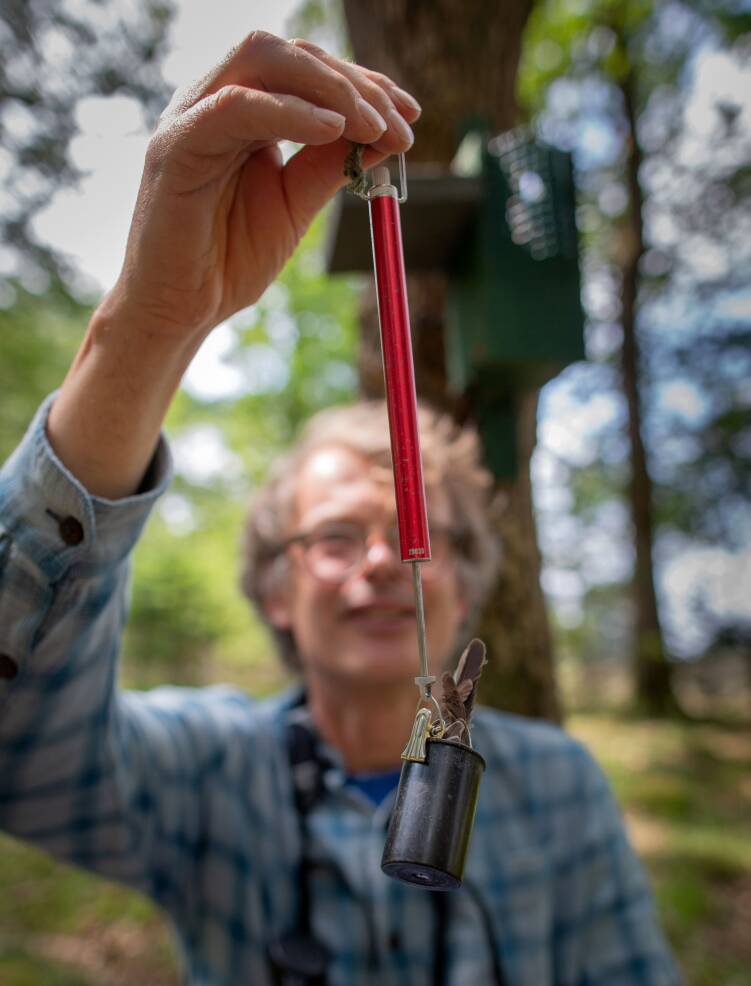
From 2007, Both was able to begin his work at the UG with a Vidi grant from the Dutch Research Council (NWO). With the help of PhD students and countless undergraduates, he set up a monitoring network of around 1,000 nest boxes in south-west Drenthe. It was painstaking work: every year, they tracked and ringed as many pied flycatchers as possible, and recorded exactly when the parent birds arrived from Africa.
‘What I wanted to find out was: how do those birds manage to arrive earlier? Is there a genetic component to it? I started looking at family trees to see whether parents who arrive early also have offspring who later arrive early themselves. That turned out to be the case.’
The biologists concluded in the years that followed that some degree of adaptation is possible. Is that good news, in the context of climate change? ‘It’s a bit of a mixed picture,’ replies Both. ‘The pied flycatcher is the champion of early arrival, but even this bird has not adapted enough. Other migratory birds, such as the willow warbler and barn swallow, are not arriving any earlier at all.’ Incidentally, spring has not come any earlier since 2006. Climate change is now mainly characterized by more extreme temperatures, rather than further earlier arrival of spring. And that is just as well, because the breeding birds are still lagging behind in their timing.
Directly to Sweden
Can birds not adapt in other ways too, for example by flying further north to “catch up” with spring? ‘Very little is known about that yet,’ says Both, ‘and it is very difficult to study.’
However, Both has begun to investigate this in recent years. As a result, he now has some clues, which point to a considerable degree of site fidelity, with birds breeding roughly where they were born. But pied flycatchers also live in Sweden, where they breed two weeks later than those in the Netherlands. With that in mind, Both and PhD student Koosje Lamers carried out a remarkable study: ‘We caught females that had arrived in the Netherlands and drove them to Sweden overnight, to an area with nest boxes. Some disappeared, others flew straight back to the Netherlands, but about a third went on to breed locally with a Swedish male. Those mixed Dutch-Swedish pairs bred two weeks earlier than local Swedish pairs, and produced almost twice as many chicks. So yes, flying directly to Sweden would indeed be a successful strategy for Dutch pied flycatchers.’
Ambassador
The relocation experiment was published in Nature in 2023, but Both has not finished and continues to work on unanswered questions, such as the role of environmental factors in the birds’ African wintering grounds. ‘If you want to understand the adaptability of migratory birds, you need a picture of their entire annual cycle, but we still know alarmingly little about what “our” birds experience in Africa.’
Both and his team also want to investigate the ecological consequences of species adapting at different rates, or not at all. ‘If you really want to know that, you need to measure how species influence one another. A key part of that is measuring who eats what. We are researching this using new DNA techniques. And yes, that means analysing bird droppings! This also helps us to make a link with the decline of insects and pest control in agriculture.’
The research may be fundamental in nature, but there is certainly a practical application, emphasizes Both: ‘If you want to make sure that the world remains liveable, you first need to know how it functions, and then how we influence it. To spread that message, we need stories. For example, the story of the pied flycatcher, which is now the ambassador of the mismatch, just as the black-tailed godwit is the ambassador of the meadows, and the spoonbill the ambassador of the Wadden Sea.’
Climate change is causing spring to arrive earlier. This discovery, made in 2001, was headline news and found its way into textbooks and even policy reports. With trees budding earlier, the peak in caterpillar numbers has been brought forward, sometimes by as much as two whole weeks. However, migratory birds are still returning from their wintering grounds at around the same time as they always have done. The result: they start breeding too late and by the time their chicks have hatched, the peak in caterpillar numbers has passed. This mismatch was a sensational discovery by Dutch biologists at the time and earned them an article in the journal Nature.
One of these biologists was Christiaan Both, now professor at the UG. ‘I was working at the Netherlands Institute of Ecology (NIOO-KNAW) at the time,’ he explains. ‘Biologists there have been monitoring birds that breed in nest boxes, including great tits and pied flycatchers, since 1955. There are therefore fantastic datasets available on these species.’
The great thing about nest boxes is that you can monitor their residents very closely, explains Both. You can record exactly when they lay their eggs and how many, when the eggs hatch, how many chicks survive, and, importantly, you can ring the chicks. If you recapture them later as adult birds, you can then track which ones mate with each other, which ones successfully raise chicks, and how old they become. ‘By around 2001, we had all the details of these populations going back decades, which was quite unique.’
Still too late
Great tits stay in the Netherlands all year round, but pied flycatchers are migratory birds that spend the Dutch winter in West Africa. ‘The females arrive in the Netherlands in mid-April and then have about ten days to choose a mate and build a nest,’ explains Both. ‘But great tits are resident birds and start laying their eggs two weeks earlier. That intrigued me. Great tits can adapt their egg-laying to conditions in the Netherlands, but pied flycatchers cannot. After all, how could they possibly know in Africa how warm it is in the Netherlands?’
Both and his colleague Marcel Visser analysed data from 1980 to 2000. ‘Over that period, spring came earlier by an average of two weeks,’ says Both. ‘We also saw that pied flycatchers started breeding about five days earlier. While this is quite impressive in such a short time, it was not enough as the birds were still too late for the caterpillar peak.’
Painstaking work
The next question was whether this has an impact on the number of flycatchers? ‘Fortunately, we have an incredible number of volunteer observers in the Netherlands who enjoy carrying out nest box surveys in many different areas,’ says Both. ‘Thanks to this, we could see that flycatcher numbers had declined dramatically, particularly in the richer deciduous forests. However, they were still doing relatively well in coniferous forests.’
race against spring
PHOTO:HERMAN ENGBERS / DE BEELDUNIE
Nohora Rueda Forero – Medische Wetenschappen
Viruses are tiny, but their impact is huge, proof that bad things (and good) come in small packages.
PROPOSITION
From 2007, Both was able to begin his work at the UG with a Vidi grant from the Dutch Research Council (NWO). With the help of PhD students and countless undergraduates, he set up a monitoring network of around 1,000 nest boxes in south-west Drenthe. It was painstaking work: every year, they tracked and ringed as many pied flycatchers as possible, and recorded exactly when the parent birds arrived from Africa.
‘What I wanted to find out was: how do those birds manage to arrive earlier? Is there a genetic component to it? I started looking at family trees to see whether parents who arrive early also have offspring who later arrive early themselves. That turned out to be the case.’
The biologists concluded in the years that followed that some degree of adaptation is possible. Is that good news, in the context of climate change? ‘It’s a bit of a mixed picture,’ replies Both. ‘The pied flycatcher is the champion of early arrival, but even this bird has not adapted enough. Other migratory birds, such as the willow warbler and barn swallow, are not arriving any earlier at all.’ Incidentally, spring has not come any earlier since 2006. Climate change is now mainly characterized by more extreme temperatures, rather than further earlier arrival of spring. And that is just as well, because the breeding birds are still lagging behind in their timing.
Directly to Sweden
Can birds not adapt in other ways too, for example by flying further north to “catch up” with spring? ‘Very little is known about that yet,’ says Both, ‘and it is very difficult to study.’
However, Both has begun to investigate this in recent years. As a result, he now has some clues, which point to a considerable degree of site fidelity, with birds breeding roughly where they were born. But pied flycatchers also live in Sweden, where they breed two weeks later than those in the Netherlands. With that in mind, Both and PhD student Koosje Lamers carried out a remarkable study: ‘We caught females that had arrived in the Netherlands and drove them to Sweden overnight, to an area with nest boxes. Some disappeared, others flew straight back to the Netherlands, but about a third went on to breed locally with a Swedish male. Those mixed Dutch-Swedish pairs bred two weeks earlier than local Swedish pairs, and produced almost twice as many chicks. So yes, flying directly to Sweden would indeed be a successful strategy for Dutch pied flycatchers.’
Ambassador
The relocation experiment was published in Nature in 2023, but Both has not finished and continues to work on unanswered questions, such as the role of environmental factors in the birds’ African wintering grounds. ‘If you want to understand the adaptability of migratory birds, you need a picture of their entire annual cycle, but we still know alarmingly little about what “our” birds experience in Africa.’
Both and his team also want to investigate the ecological consequences of species adapting at different rates, or not at all. ‘If you really want to know that, you need to measure how species influence one another. A key part of that is measuring who eats what. We are researching this using new DNA techniques. And yes, that means analysing bird droppings! This also helps us to make a link with the decline of insects and pest control in agriculture.’
The research may be fundamental in nature, but there is certainly a practical application, emphasizes Both: ‘If you want to make sure that the world remains liveable, you first need to know how it functions, and then how we influence it. To spread that message, we need stories. For example, the story of the pied flycatcher, which is now the ambassador of the mismatch, just as the black-tailed godwit is the ambassador of the meadows, and the spoonbill the ambassador of the Wadden Sea.’
PHOTO:HERMAN ENGBERS / DE BEELDUNIE
Christiaan Both (1969) has been a keen birdwatcher since childhood. He studied biology in Wageningen, Groningen, and Oxford, and in 2012 became Professor of Animal Ecology at the University of Groningen. Both investigates the impact of climate change on bird phenology, and his work on migratory birds is internationally renowned.
De ontdekking uit 2001 haalde de kranten, de studieboeken en zelfs de beleids-rapporten: door klimaatverandering begint de lente steeds eerder. De bomen lopen eerder uit, waardoor ook de piek in het aantal rupsen naar voren is geschoven, soms wel twee hele weken. Maar trekvogels arriveren nog altijd rond dezelfde datum uit hun overwinterings-gebieden. Daardoor beginnen ze feitelijk te laat met broeden: zodra hun jongen uit het ei komen, is de rupsenpiek alweer voorbij. Deze ‘mismatch’ was destijds een opzienbarende ontdekking van Nederlandse biologen. Ze haalden er het tijdschrift Nature mee.
Een van hen was Christiaan Both, tegenwoordig hoogleraar aan de RUG. “Ik werkte toen bij het Nederlands Instituut voor Ecologie (NIOO)”, vertelt hij. “Daar volgen biologen al sinds 1955 vogels die in nestkasten broeden, waaronder koolmezen en bonte vliegenvangers. Daarvan zijn dus fantastische datareeksen beschikbaar.”
Het leuke aan nestkasten is dat je hun vogelbewoners heel goed kunt volgen, legt Both uit. Je kunt precies noteren wanneer ze eieren leggen, hoeveel, wanneer die uitkomen, hoeveel jongen er groot worden... en heel belangrijk: je kunt de jongen ringen. Als je ze later terugvangt als volwassen vogels, kun je dus volgen welke met elkaar paren, welke er succesvol jongen voortbrengen, hoe oud ze worden... “Rond 2001 wisten we dus al decennialang alle details van die populaties. Heel uniek.”
Nog steeds te laat
Koolmezen blijven het hele jaar door in Nederland, maar bonte vliegenvangers zijn trekvogels. Zij brengen onze winters door in West-Afrika. “De vrouwtjes komen half april aan in Nederland, en hebben dan een dag of tien de tijd om een man te kiezen en een nest te bouwen”, vertelt Both. “Maar koolmezen zijn dus standvogels. Die beginnen twee weken eerder met leggen. Dat intrigeerde mij. Koolmezen kunnen hun eileg aanpassen aan de omstandigheden hier in Nederland, maar bonte vliegenvangers niet. Hoe zouden die in Afrika kunnen weten hoe warm het in Nederland is?”
Both en zijn collega Marcel Visser analyseerden data van 1980 tot 2000. “In die periode is de lente gemiddeld twee weken naar voren geschoven”, zegt Both. “En we zagen dat de bonte vliegenvangers een dag of vijf eerder zijn gaan broeden. Best indrukwekkend, in zo’n korte tijd, maar niet genoeg: de vogels waren nog steeds te laat voor de rupsenpiek.”
Monnikenwerk
De vervolgvraag was: heeft dat gevolgen voor de aantallen vliegenvangers? “Gelukkig zijn er in Nederland ongelooflijk veel vrijwillige waarnemers die het leuk vinden om nestkast-onderzoek te doen”, vertelt Both, “in allerlei verschillende gebieden. Daardoor konden we zien dat de vliegenvangers vooral in de rijkere loofbossen enorm achteruit waren gegaan. In naaldbossen deden ze het nog relatief goed.”
25 years ago, biologist Christiaan Both was one of the researchers who discovered a mismatch between birds’ breeding season and the timing of peak food supply, with many birds breeding too late with spring coming earlier. Follow-up research has shown that birds are capable of adapting, but does this apply to all species and can they adapt quickly enough?
TEXT: NIENKE BEINTEMA